For investors

Numbers first. Then the keys.

Yield reality, verified projects and honest risk analysis for property investors in Phuket and Koh Samui.

The Thailand market in numbers

Live, sourced figures - updated from official statistics and operator data.

+5.1%
Phuket condo price growth, year on year

Bank of Thailand, Residential Property Price Index · June 2026

+4%
Phuket villa price growth, year on year

Bank of Thailand, Residential Property Price Index · June 2026

12.74M
visitors to Phuket (Jan-Nov 2025)

TAT · Bangkok Post

79.5%
average hotel occupancy

TAT · CBRE · C9 Hotelworks

Why Thailand for property investment

Thailand's ownership law for foreign buyers is narrower than in many markets, but within that narrower lane the product performs. A foreigner can hold a condominium freehold under the Condominium Act provided the building's foreign quota (49% of sellable area) is not exhausted. That freehold is registered at the Land Department, mortgageable and transferable. The legal path is clear and documented; buyers lose money by ignoring it, not because it is obscure.

Phuket and Koh Samui sit at the premium end of Southeast Asian resort markets. Average daily rates for quality branded accommodation have risen steadily since the 2022 reopening, and the buyer pool for resale is genuinely international: European and North American buyers, Russians, Chinese and a fast-growing group of digital nomads treating Thailand as a semi-permanent base. That diversity of demand matters for exit liquidity.

As of mid-2025, residential condo prices in Phuket have compounded at single-digit annual percentages over a five-year trailing window (Bank of Thailand index). That is not spectacular capital growth; the investment case rests on yield plus moderate appreciation, not on leverage and a rising tide. Buyers who underwrite on yield survive corrections; buyers who underwrite on 'the market always goes up' do not.

Yield reality: gross vs net

Developer brochures quote gross yield, almost always against a high-season rate and high-season occupancy assumption. The spread between brochure gross and achievable net is the single most important number in Thai resort investment. It is typically between six and ten percentage points.

What eats the spread: a property management fee of 20-30% of gross rental revenue is standard for a managed programme; this alone cuts a 10% gross yield to 7-8% before any other costs. Add platform fees (OTA commissions average 15-18%), annual maintenance fund contributions (typically 1-2% of purchase price per year for well-run buildings), electricity and water at owner tariffs (not the subsidised domestic rate), and periodic refurbishment. A realistic net yield on a well-performing Phuket condo after all-in costs lands between 4% and 6% per year. Some buildings do better; some projects quoted at 8-10% gross struggle to break 3% net once the first management report arrives.

Guaranteed rental programmes deserve specific scrutiny. Developers offering 5-7% guaranteed returns for five to eight years are typically funding the payout from the project's development margin - you are lending the developer money at a low rate and calling it a rental guarantee. Once the guarantee period ends, actual market yields often disappoint. The better question is: what does an operator in a non-guaranteed programme in the same building actually earn? Demand that operating data before comparing guaranteed and non-guaranteed options.

Investment strategies

Off-plan vs ready-to-move

Off-plan buying offers a price discount (typically 15-25% below completed comparable) and a staged payment schedule that reduces the capital requirement at signing. The trade-offs are construction risk (delays are common; three years can become five), the absence of rental income during the build and the inability to inspect what you are paying for. Off-plan suits buyers with a longer horizon who can absorb a delay and who have verified the developer's track record on previous projects - specifically, actual delivery dates, not marketing promises.

Ready-to-move

Ready-to-move properties give you a concrete building to inspect, an operating history to audit, and rental income from day one. The price is higher. In a rising market you forgo some of the appreciation that off-plan captures; in a flat market you avoid the construction and developer risk entirely. For buyers with a shorter horizon or who are investing for income rather than capital gain, ready stock in an established building with a proven rental record is the more predictable position.

Condo vs villa

Condos offer foreign freehold ownership, lower ticket sizes, simpler management and higher liquidity. Villas offer privacy and premium-rate rentals but land ownership by foreigners is legally restricted to leasehold (30 years, registered and renewable by negotiation) or company structures that require Thai legal counsel and ongoing compliance. Villa short-term rental income per square metre is often higher, but the management overhead and the seasonal concentration of bookings mean occupancy risk is also higher. Neither is generically better. The right choice depends on budget, intended hold period and how much operational complexity you want to carry.

How we evaluate an investment

  • Yield, honestly computed

    Gross yield headlines mean little. We model net returns after fees, management and realistic low-season occupancy.

  • Occupancy over promises

    We ask for real booking calendars from past seasons - the difference between projects is operator quality, not brochures.

  • Management decides returns

    Identical units in neighbouring buildings earn visibly different income. Who runs the building is a first-order question.

  • Exit before entry

    We only recommend what can be resold: liquid areas, clean titles, foreign quota available for the next buyer too.

Risks worth naming

Developer risk

Off-plan projects in Thailand have stalled, been abandoned and delivered units materially different from the contract specification. Verify the developer's completed project count, check that the land title is clean (not in a Thai company structure that could be dissolved) and confirm construction financing is in place before signing.

Management quality

Two condos with identical specs in neighbouring buildings can produce yields that differ by three or four percentage points. The variable is operator quality: booking channel mix, maintenance standards, pricing discipline and how professionally they handle guest reviews. This is harder to evaluate from a brochure than price per square metre. Ask for actual booking calendars from at least two completed seasons.

Foreign quota

The 49% foreign-ownership limit on condos is not negotiable and is tracked per building. Some popular buildings are quota-full, meaning the next buyer must take a Thai-name structure that is not equivalent to freehold. Check the current quota status of any building before you agree a price. A quota-full building should trade at a discount; it sometimes does not.

Currency and repatriation

All property purchases in Thailand must be funded by incoming foreign-currency transfers supported by a Foreign Exchange Transaction (FET) form. Without this document you cannot register foreign ownership and you cannot legally repatriate the sale proceeds when you exit. The FET requirement is not an afterthought - it must be set up before the first transfer, and mistakes here are expensive to fix.

Projects with yield estimates

View the full catalogue

Estimates are sourced from developer and operator data and are not a guarantee of future income.

1–3-bed Villa · 120–194 m² · Samui

Cocoon Villas Maenam
Under construction

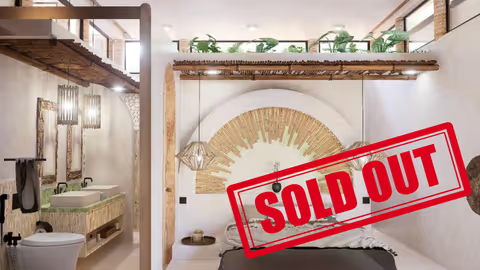
Fifteen pool villas from 120 to 194 sqm under construction in Maenam, a north-coast district favored by buyers seeking quieter island living and rental investors targeting families and longer-stay guests.

฿3,990,000

฿33,250 / m²

Est. yield 22.82% / year

Updated 14 Aug 2026

2–3-bed Villa · 251–262 m² · Samui

Nam Jai Residence
Pre-sale

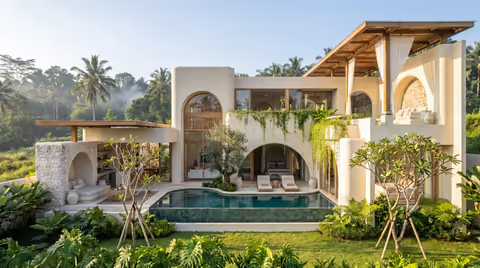
A boutique collection of six private-pool villas in Maenam, Koh Samui. Two- and three-bedroom layouts from 251 to 262 sq m, currently at pre-sale stage.

฿8,000,000

฿31,870 / m²

Est. yield 21% / year

Updated 14 Aug 2026

Studio-3-bed Condo · 26.5–70.4 m² · Phuket

Sun Hills Layan
Under constructionCompletion Dec 2027Sea view

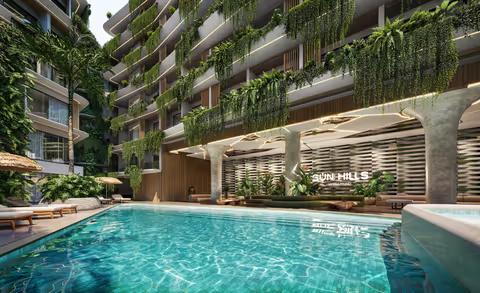
A 585-unit resort condominium under construction in Bang Tao, scheduled for completion in December 2027, with studios and one-bedroom units ranging from 26.5 to 70.4 sq m.

฿4,005,000

฿133,000 / m²

Est. yield 15% / year

Updated 7 Jul 2026

2-bed Villa · 70 m² · Samui

Wild Orchid 2 Maenam Seaview
PlannedCompletion Q1 2027Sea view

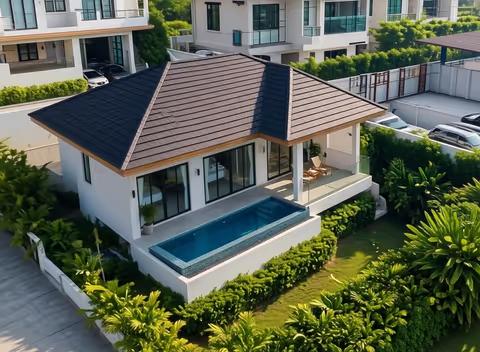
A compact collection of 9 two-bedroom seaview villas in Maenam, northern Koh Samui, scheduled for completion in Q1 2027.

฿6,900,000

฿98,570 / m²

Est. yield 14% / year

Updated 24 Aug 2026

Villa · 155–366 m² · Koh Phangan

Lagoon Koh Phangan
Under constructionCompletion Dec 2028

A 69-villa project on Koh Phangan delivering private-pool residences from 155 to 366 sq m, due for completion in December 2028.

฿5,200,000

Est. yield 11.9% / year

Updated 20 May 2026

Common investor questions

What net yield should I expect from a Phuket condo?

On a well-run managed programme in a quality building, 4-6% net per year is a realistic expectation as of 2025. Headline gross figures of 8-10% in developer marketing assume full-season occupancy and omit management fees, platform costs and maintenance. Ask any seller for a net yield calculation that itemises each deduction.

Is a guaranteed rental return safe?

Guaranteed returns are typically funded from the developer's margin, not from actual rental income. They last for the guarantee period (usually 5-8 years) and the payout often bears no relation to what the unit actually earns. They can make financial sense if the purchase price is set at a discount that accounts for the guarantee structure. Request a breakdown of how the developer funds the guarantee before deciding.

Can I own the land under a villa?

Not in freehold as a foreign individual. Land ownership is restricted to Thai nationals and qualifying Thai entities. Foreign villa buyers use registered leasehold (30-year lease recorded at the Land Department, which is legally sound) or a Thai limited company (requires proper legal structuring and ongoing compliance). Both are used routinely; neither is risk-free. Engage a licensed Thai lawyer before signing, not after.

How do I check if a developer is reliable?

Start with completed projects: visit at least one finished building and ask the management office about actual delivery dates versus original promises. Check that the developer holds the land title (chanote or nor sor sam kor at minimum) in a form that cannot be dissolved or encumbered. Confirm that construction financing is in place, not contingent on presales. The Land Department and Department of Business Development registers are publicly searchable.

Which areas have the strongest rental demand?

Bang Tao and Layan on Phuket's west coast consistently produce the deepest short-term rental demand and the most liquid resale market. Kamala, Surin and Karon follow. On Koh Samui, Bophut has the strongest premium rental base. Rawai in southern Phuket earns on long-stay rather than nightly rates. See the area guides for the investment thesis per location.

When should I consider selling vs holding?

Thai resort property rewards patient holders. Exit costs are material: transfer fee (2% of appraised value), specific business tax (3.3% if held under five years) or stamp duty (0.5%), plus withholding tax (1-3% for companies, progressive for individuals). Flipping in under three years is rarely profitable after costs. The most effective exit horizon is typically five to ten years, with rental income covering carry costs and moderate appreciation producing the capital gain.